
From Vision to Riding Arena: Planning Your Modern Equestrian Centre
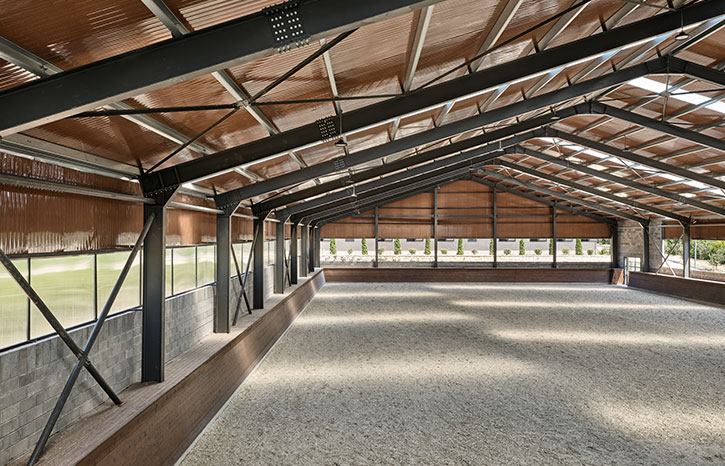
Planning a riding arena or equestrian centre demands the same rigour as designing a high-performance sports facility. Every detail—from orientation to arena surface—influences performance and safety. Designing a riding arena is not merely a matter of building four walls and a roof: it means creating a space that inspires horse and rider to achieve their best.
At Equine Design Studio, we have designed riding arenas for private equestrian operations, Olympic training centres, and international competition organisers. Our experience shows that the most critical decisions are often made long before construction begins.
Site Analysis as the Foundation
Wind direction, sunlight, and ground drainage define where your riding arena belongs on the site. Morning light should fall onto the riding surface; cross-winds reduce dust development. Good design begins long before the first line is drawn.
A professional site analysis also encompasses investigation of subsoil load-bearing capacity, proximity to utility infrastructure, and consideration of future expansion possibilities. Within an equestrian facility planning process, this phase represents by far the most valuable investment of time.
Structure and Materials
Choose a light yet robust construction: glulam timber, steel, or hybrid systems. The roof structure must guarantee unobstructed sight lines and prevent condensation. Technical precision in system solutions demonstrates how engineering excellence ensures longevity—architecture adds identity and beauty.
Timber frame construction with a steel core has proven particularly cost-effective for arena buildings. Clear spans of 20 to 40 metres are achievable without intermediate supports, offering maximum operational flexibility. Coated steel purlins with thermal insulation prevent condensation formation—a common problem in inadequately planned arenas.
Arena Surface and Acoustics
Riding arenas are sensory spaces. Appropriate surface depth, sound absorption, and balanced lighting make an enormous difference. Indirect LED systems eliminate glare, while calibrated acoustic panels reduce echoes—a decisive factor for sound-sensitive horses.
The optimal arena surface consists of a permeable base course, a geotextile separation layer, and a multi-layer riding surface of sand, rubber granulate, and fibre. Total depth should lie between 8 and 12 centimetres. Equine Design Studio collaborates with specialist ground construction experts to guarantee optimal results.
Integration into the Overall Facility
A well-designed arena connects seamlessly with stables, parking, and spectator areas. Riders should flow naturally from stable through warm-up area to the main surface. Visitors require clear access routes without disrupting the riding operation.
For competition facilities in particular, the separation of spectator and equine traffic is safety-critical. Clear access routes, separate entrances for horses and spectators, and adequately dimensioned parking areas are not merely comfort issues but essential safety requirements.
Sustainability and Maintenance
Rainwater harvesting for footing irrigation, daylight roofing, and energy-efficient ventilation systems reduce long-term operating costs. Think beyond aesthetics—design is performance. A forward-looking arena recoups its additional costs through lower operating expenditure within 10 to 15 years.
Photovoltaic installations on an arena roof offer an excellent opportunity to meet the facility’s energy demands. The south-facing orientation of many arenas makes them ideal carriers for solar modules, generating clean energy while protecting the riding surface below.
Planning with Long-Term Vision
The best riding arena is the one that grows with your facility. Modular extension options, flexible partitions, and pre-installed connections for future expansion are investments that pay long-term dividends.
Equine Design Studio always plans with a time horizon of at least 20 years. We design not just for today’s requirements, but for the ambitions your facility will develop over time.
Let Equine Design Studio design a riding arena that unites engineering, architecture, and equestrian artistry.