
Stable Architecture: Where Horse Welfare Meets Design
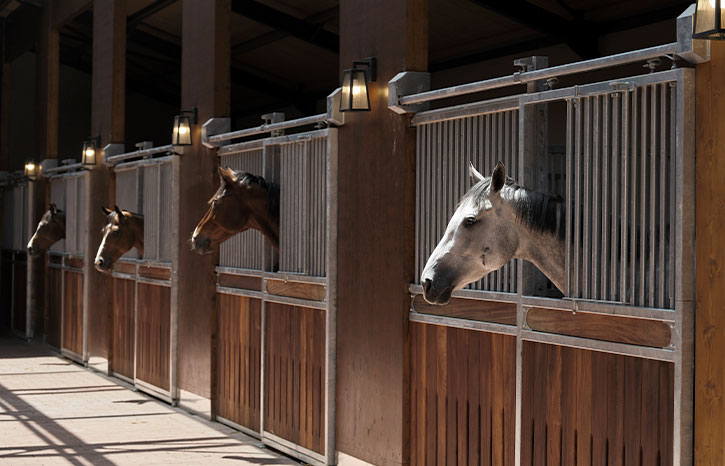
A horse stable is more than a building—it is a habitat. Good architecture respects the horse’s natural instincts: light, air, movement, and social contact. Yet many modern stable systems still prioritise equipment over wellbeing. How can architecture and design resolve this contradiction?
At Equine Design Studio, horse welfare is the starting point of every project—not an afterthought. Our experience shows: when architecture and animal welfare are designed together, spaces emerge in which horses thrive and people enjoy working.
The Problem with Conventional Stalls
Traditional horse stables often confine horses in small, dark boxes. Restricted ventilation leads to respiratory problems, while isolation encourages stereotypic behaviours such as cribbing, weaving, or box-walking. Studies demonstrate that horses in poorly designed stables show significantly elevated cortisol levels.
Stable architecture can transform this dynamic—not through expensive add-on systems, but through informed spatial decisions.
Light and Air—The Most Vital Resources
Generous windows and skylights create rhythm and calm. Cross-ventilation keeps air fresh and temperatures stable. Open grid partitions or large-format stable door systems demonstrate how equipment can support architectural intent—when used creatively.
A well-conceived stable harnesses natural thermodynamics: warm air rises, exits through ridge ventilation, and draws in fresh air from below. This simple principle significantly reduces ammonia concentrations in the stable atmosphere—and thereby the risk of chronic respiratory conditions.
Spatial Awareness
Design for movement. Stable aisles should provide adequate width for two horses to pass safely. Ceiling heights above 3.5 metres create generous air volume; wall surfaces must be impact-resistant yet pleasant in appearance. A horse perceives proportions—and calm spaces produce calm horses.
The optimal box size for a warmblood is a minimum of 3.5 × 3.5 metres, ideally 4 × 4 metres. Open-fronted loose boxes or run-out boxes represent the gold standard for equine welfare and should be incorporated into every modern facility plan.
Materials with Meaning
Choose natural textures. Timber regulates humidity and provides acoustic damping. Steel guarantees safety with minimal wall thickness. Reflective or reverberant surfaces should be avoided—they unsettle animals. Integrated sound-absorbing panels considerably improve comfort.
In riding arenas in particular, where group lessons and sound systems are routine, acoustic design is a frequently underestimated factor. Equine Design Studio plans reverberation and sound distribution as an integral part of the architectural concept.
Social and Visual Contact
Transparent partitions, sliding grilles, and thoughtfully designed stable fronts allow horses to see and scent each other—thereby reducing anxiety. This seemingly minor design decision has measurable impacts on wellbeing: horses with visual contact display fewer stereotypies and less aggressive behaviour.
Modern stable equipment systems today offer a wide range of options that enable social contact while maintaining safety—from lattice partition elements to flexible hay and water pass-through angles.
The Human Perspective
A well-designed stable also supports the people who work within it: natural light for grooms, logical work flows, accessible tack rooms and feed areas. Stable architecture bridges human and equine comfort—without compromising either.
Staff working in comfortable conditions are more satisfied, more productive, and remain with the operation longer. This human dimension is an investment that pays dividends in performance and retention.
Discover how Equine Design Studio unites architecture and horse welfare in every project.